An air conditioner that is running but not cooling the room properly can quickly become frustrating, especially during hot weather. Your AC may appear to be operating normally—the indoor fan may be running and air may be coming from the vents—but the temperature inside the room may remain uncomfortable.
Several factors can reduce an air conditioner's cooling performance, ranging from simple problems such as dirty filters and incorrect temperature settings to technical issues involving refrigerant, coils, fans, sensors, electrical components, or the compressor.
Doorstep Hub brings you this practical guide to help you understand the common reasons why an AC may not be cooling and what you can safely check before requesting professional AC repair assistance.
Why Is My AC Running but Not Cooling?
An air conditioner works by circulating indoor air through the cooling system and transferring heat outside. If airflow is restricted or an important cooling component is not functioning correctly, the AC may continue running without providing the expected cooling.
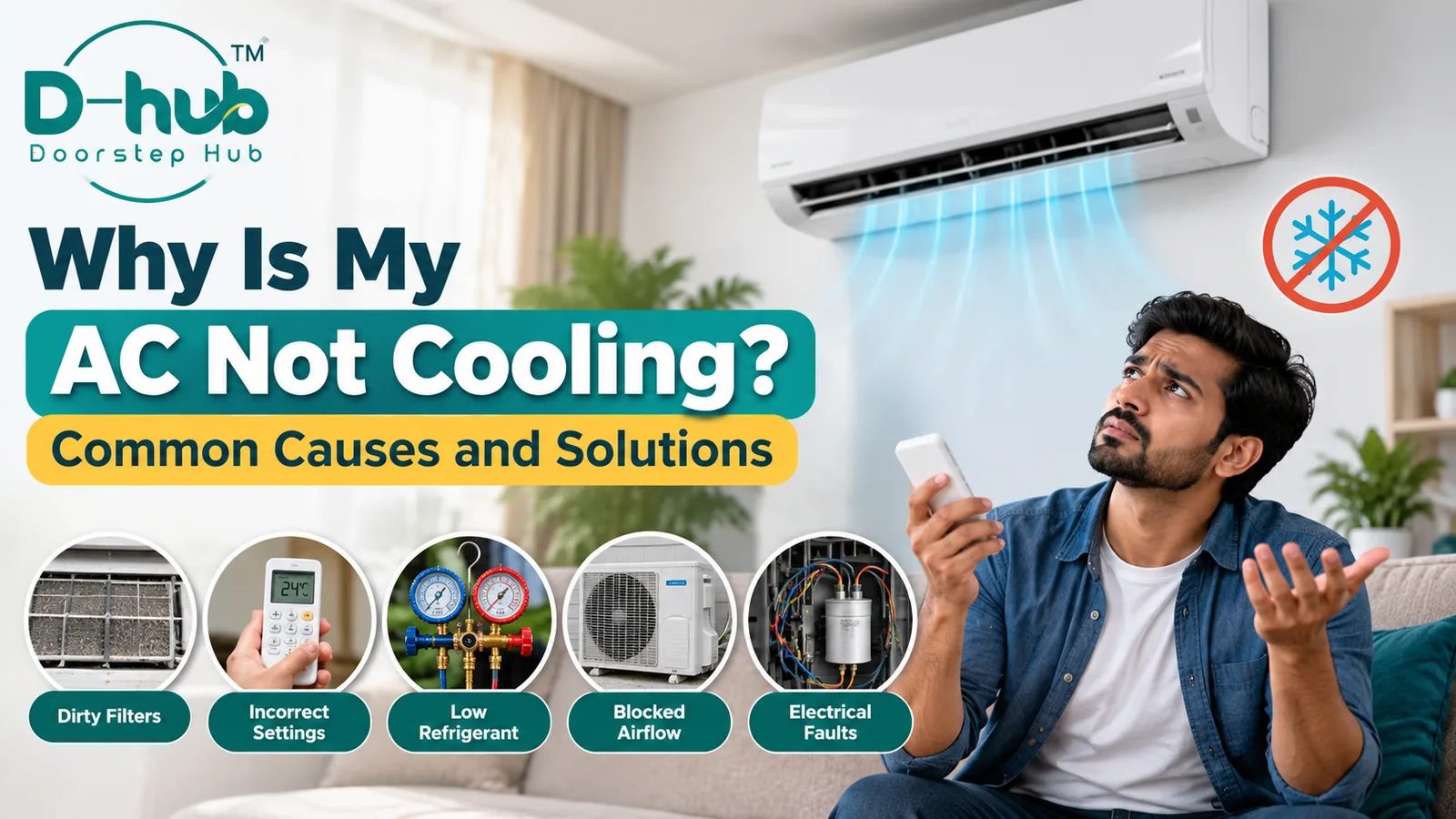
Common reasons include:
- Dirty or clogged air filters
- Incorrect thermostat or temperature settings
- Low refrigerant levels
- Refrigerant leakage
- Dirty evaporator or condenser coils
- Blocked indoor or outdoor airflow
- Outdoor unit problems
- Fan motor issues
- Sensor problems
- Capacitor or electrical faults
- Compressor problems
Identifying the actual cause is important before attempting any repair.
1. Check the AC Temperature and Mode Settings
Before assuming there is a technical problem, check the settings on your AC remote or thermostat.
Make sure the air conditioner is set to Cool Mode rather than Fan, Dry, or another operating mode.
The selected temperature should also be lower than the current room temperature.
Check These Settings
- Select Cool Mode.
- Reduce the set temperature appropriately.
- Confirm the fan is operating.
- Check whether Sleep or Eco Mode is affecting performance.
- Replace the remote batteries if controls are not responding properly.
Incorrect settings can sometimes make an otherwise properly functioning AC appear to have a cooling problem.
2. Clean Dirty or Clogged Air Filters
Air filters collect dust and other airborne particles while the AC operates. Over time, excessive dust can restrict airflow through the indoor unit.
Reduced airflow can affect cooling efficiency and may cause the AC to take longer to cool the room.
What You Can Do
Switch off the AC and inspect accessible filters according to the manufacturer's instructions.
If the filters are washable, clean them carefully and allow them to dry completely before reinstalling them.
Filters that are damaged or unsuitable for reuse may need replacement.
Regular filter maintenance can help maintain proper airflow and cooling performance.
3. Keep Doors and Windows Closed
An AC may struggle to cool a room when doors or windows are continuously open.
Warm outside air entering the room increases the cooling load and can make the AC operate for longer periods without reaching the selected temperature.
For better cooling:
- Close doors and windows.
- Reduce unnecessary entry of outside air.
- Use curtains or blinds where strong sunlight enters the room.
- Check for significant gaps around doors or windows.
A properly enclosed room allows the air conditioner to cool the space more efficiently.
4. Check for Blocked Indoor Airflow
Furniture, curtains, decorative items, or other objects placed directly in front of the indoor AC unit can interfere with airflow.
Make sure the air outlet is unobstructed and that cool air can circulate freely throughout the room.
Also check whether the AC louvers are positioned appropriately.
If airflow remains weak even after cleaning the filters and removing obstructions, the indoor fan, evaporator coil, or another internal component may require inspection.
5. Inspect the Outdoor Unit Area
The outdoor unit releases heat collected from inside the room. It requires adequate ventilation to operate properly.
Dust, leaves, objects, or restricted space around the outdoor unit can affect heat dissipation.
Basic Outdoor Unit Checks
- Keep the surrounding area clear.
- Remove visible leaves or loose debris around the unit without opening it.
- Make sure airflow is not blocked by stored items.
- Check whether the outdoor fan appears to operate when the AC is running.
Do not open the outdoor unit or touch electrical components.
6. Low Refrigerant or Refrigerant Leakage
Refrigerant plays an important role in the AC cooling process.
If refrigerant levels become insufficient because of leakage or another system issue, the AC may run continuously while producing inadequate cooling.
Possible signs may include:
- Reduced cooling
- AC taking unusually long to cool
- Ice formation around certain components
- Changes in normal system operation
Refrigerant problems require professional diagnosis.
Simply adding refrigerant without identifying a possible leak may not provide a proper long-term solution. A trained technician should inspect the system and determine the appropriate repair.
7. Dirty Evaporator or Condenser Coils
Your AC relies on coils to absorb and release heat.
Dust and dirt accumulated on the evaporator or condenser coils can interfere with heat transfer and reduce cooling performance.
While routine filter cleaning can be performed by many users, deeper coil cleaning should be handled carefully.
Professional AC maintenance can include inspection and cleaning of the cooling components where required.
8. Fan or Motor Problems
Both indoor and outdoor fans play important roles in the cooling process.
A faulty fan motor, damaged capacitor, electrical issue, or mechanical problem may cause:
- Weak airflow
- Outdoor fan not running
- Unusual sounds
- Intermittent operation
- Poor cooling
These components should be inspected by a qualified technician rather than repaired without appropriate technical knowledge.
9. Sensor, PCB, or Electrical Problems
Modern air conditioners contain sensors and electronic control systems that regulate temperature, compressor operation, fan speed, and other functions.
A faulty sensor, PCB, capacitor, wiring connection, or electrical component may affect cooling even when the AC appears to be switched on.
Possible symptoms include:
- Incorrect temperature detection
- AC switching on and off unexpectedly
- Error codes
- Outdoor unit not starting
- Intermittent cooling
- Unresponsive controls
Professional diagnosis can help determine whether the problem is related to the electronic controls or another AC component.
10. Compressor Problems
The compressor is a critical part of an air conditioning system.
If the compressor is not operating correctly, the AC may fail to provide proper cooling even though the indoor fan continues to run.
Compressor-related problems require professional testing because several other faults can produce similar symptoms.
Avoid assuming that the compressor needs replacement until the AC has been properly diagnosed.
When Should You Call an AC Technician?
Consider requesting professional AC assistance when basic checks do not restore cooling or when you notice symptoms such as:
- AC running but not cooling
- Very weak cooling
- Outdoor unit not working
- Ice formation
- Water leakage
- Unusual sounds
- Burning smell
- Frequent switching on and off
- Error codes
- Electrical problems
- Cooling stopping repeatedly
- Compressor or PCB-related symptoms
Avoid opening the indoor or outdoor unit, handling electrical wiring, or attempting refrigerant-related repairs yourself.
Air conditioners contain electrical components and pressurized refrigeration systems that require appropriate equipment and technical knowledge.
Expert AC Repair Support with Doorstep Hub
If your air conditioner is running but not cooling properly, Doorstep Hub can help you connect with service professionals for AC inspection, troubleshooting, maintenance, and repair assistance.
Whether the problem is related to dirty filters, poor airflow, refrigerant leakage, cooling coils, fan motors, sensors, capacitors, PCB components, electrical faults, or compressor performance, professional diagnosis can help identify the actual cause before repairs are carried out.
Doorstep Hub provides convenient access to AC service assistance for customers experiencing cooling and other air-conditioning problems.
Need Expert AC Support?
📞 Helpline: 8886688666
🌐 Website: doorstephub.com
📲 Download the Doorstep Hub App
https://doorstephub.com/app
Frequently Asked Questions
Common troubleshooting questions answered by our specialists
Was this article helpful?
Your feedback helps us improve our repair guides and service tips.